
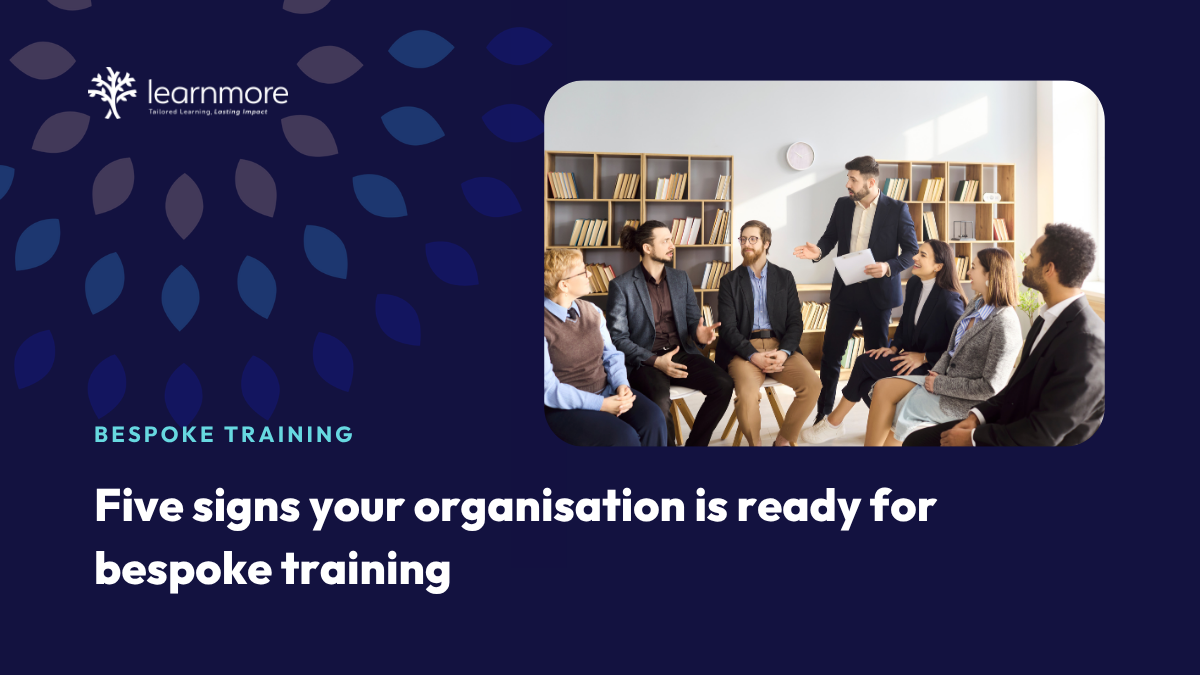
The workshop went well. The trainer was engaging, the room was lively, and the feedback forms came back full of eights and nines. Then everyone went back to work, and within a month it was as if the training had never happened.
If that story sounds familiar, you are not doing training wrong, and it does not mean the course was bad. Content built for a general audience is exactly right for plenty of needs, recognised qualifications and standard skills among them. But some challenges are specific to one organisation, and when yours are, the training needs to be built around them. Here are five signs your organisation is ready for that, with a practical test for each one.
1. The feedback is polite rather than enthusiastic
There is a difference between training people enjoyed, and training people are still talking about. Polite feedback says the day was fine. Enthusiastic feedback says something landed, a moment where a manager recognised their own situation in the material and saw a way through it.
The test. Look at the free text comments on your last few feedback forms, not the scores. If they praise the trainer and the lunch but nobody mentions a specific thing they will do differently, the content did not connect with their reality.
2. The examples never sound like your organisation
Content built for a general audience runs on general case studies. A fictional company, a tidy scenario, a conflict that resolves neatly in a role play. Your managers sit through it thinking, that is not what it is like here. And they are right. A difficult conversation on a depot floor at six in the morning is not the same as one in a quiet meeting room, and a manager in catering faces different pressures from one in an office.
The test. Ask three people who attended your last course to describe one example from it. If none of the examples could have happened in your organisation, your people spent the day translating instead of learning.
3. Managers cannot apply it to their real scenarios
This is the sign that matters most, because application is the whole point. Training sticks when someone can take what they heard on Thursday and use it on Monday. When the content is built for everyone, the gap between the course and the day job is left for each manager to bridge alone, and most people, busy and back under pressure, never do.
The stakes here are higher than a wasted training budget. Research by the Chartered Management Institute and YouGov found that 82% of managers who enter management positions have not had formal management and leadership training, and the same research found that managers who do receive formal training are significantly more likely to trust their teams and feel comfortable leading change. When training does not transfer, those managers stay untrained in practice, whatever the attendance record says. We wrote about where that leads in why your best people do not always make your best managers.
The test. A month after any training, ask attendees one question. What have you done differently because of it? If the honest answer is nothing, the problem is fit, not effort.
4. The same problems keep coming back
You ran the difficult conversations course, and conversations are still being avoided. You covered absence management, and the same patterns are still in the numbers. When training treats the symptom in general terms rather than your organisation’s version of the problem, the underlying issue stays put and resurfaces every six months, usually with a request for more training.
The test. Look at what you have trained on in the last two years and what still appears on your risk or people agenda. Anything on both lists is a candidate for a different approach, not another run of the same course.
5. Values and culture feel bolted on
If your organisation has done real work on its values, generic training can quietly undo it. An external course carries its own language and its own assumptions, and when those clash with yours, managers notice. Culture change sticks when every part of the employee experience, including training, speaks the same language.
The test. Put your values statement next to the course materials from your last programme. If the two could belong to different organisations, they did.
What to do if three or more sound familiar
None of this means abandoning off the shelf training altogether. When the need is a recognised skill, a professional credential or structured career development, accredited content is exactly the right tool, it is why we deliver ILM leadership and management qualifications, IWFM facilities management qualifications, Women in Leadership programmes and apprenticeships alongside our bespoke work. The skill is matching the tool to the challenge, and we have written a guide to making that call, bespoke or off the shelf, how to choose the right training for your organisation.
But when the challenge is specific to you, the training should be too. We design bespoke programmes by listening first, then building around your scenarios, your values and your culture, for organisations including Mitie, Southeastern, Go Ahead London, Fuller’s and Impact Food Group. That is tailored learning, and the lasting impact shows in the data. 98% of our learners say they feel more confident in their role, and confidence is what turns a course into a change.
Every programme starts with a discovery call. It costs nothing, there is no obligation, and it begins with your challenges rather than our brochure. If you counted three signs or more, that conversation is probably overdue.
Book a discovery call or visit our bespoke training page, or call us on 0800 111 4992.
Aarrange a call about your organisation’s needs
*Our articles are accurate at the time of publication, but course details, funding and industry standards can change. They’re here to inform rather than to replace formal advice, so if you’re weighing up a decision, get in touch and we’ll help you find the right path.